Why EU trademark registration matters
An unregistered brand has limited legal protection. In the EU, unregistered marks can claim some protection under national unfair competition laws, but only in the specific territory where the mark has acquired distinctiveness through use. A registered EU trademark provides exclusive rights across all 27 EU member states from a single filing, regardless of where you have actually used the mark.
Registration also establishes priority: your rights date from the filing date, not the date of first use or the date the certificate is issued. If a third party files a similar mark the day after you, your earlier filing date defeats their application.
The EU Trade Mark (EUTM) via EUIPO
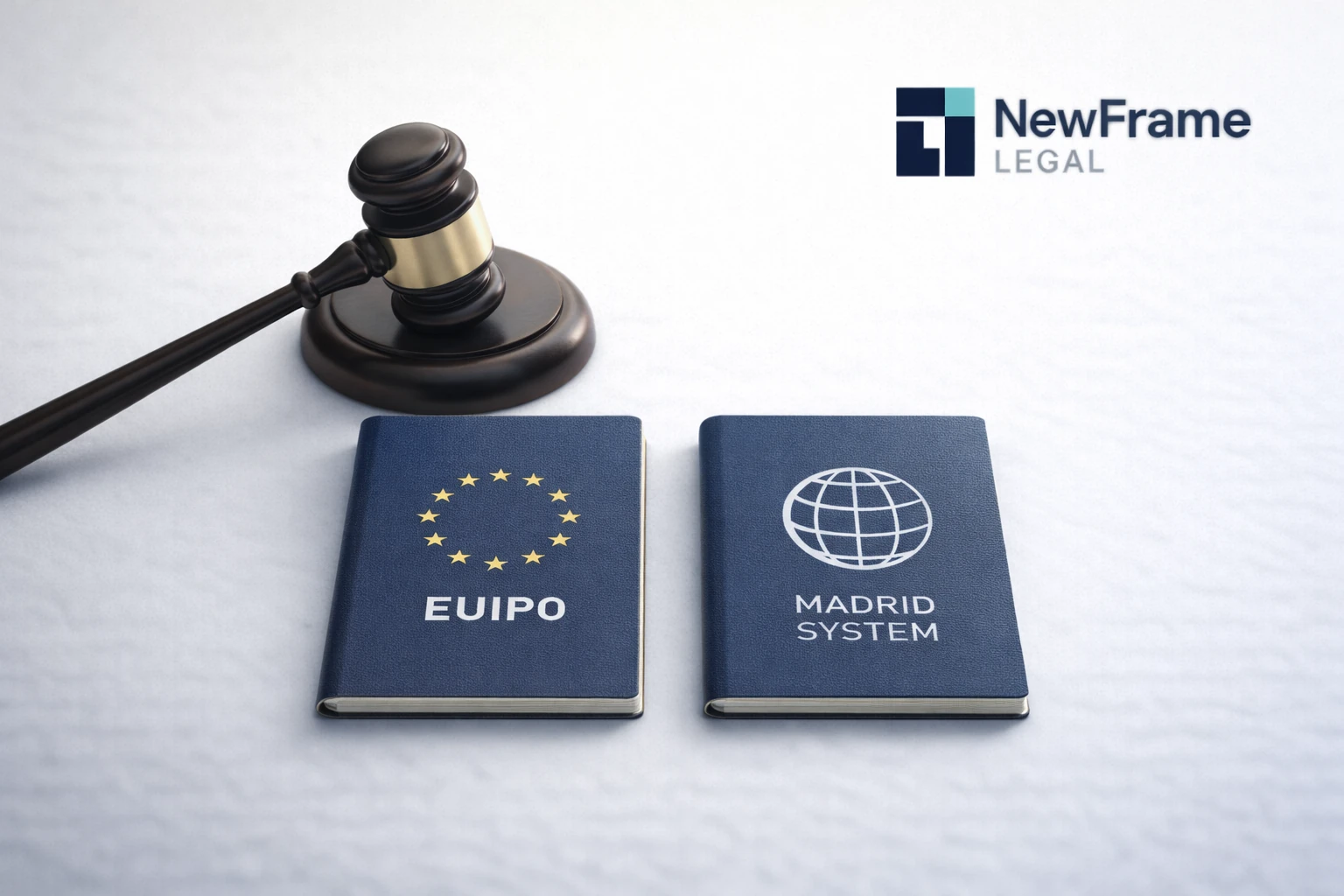
The European Union Intellectual Property Office (EUIPO), based in Alicante, Spain, administers the EU trademark system. A single EUTM application covers all 27 EU member states and provides unitary protection — it cannot be registered in some member states and refused in others.
Timeline: examination and registration typically takes 4–6 months if there are no objections and no oppositions from third parties. The opposition period (3 months from publication) can extend this.
Cost: the EUIPO basic filing fee is €850 for one class of goods or services (online filing). Each additional class costs €50 for the second and €150 for each subsequent class. This covers a 10-year registration, renewable indefinitely for the same fee every 10 years.
Use requirement: a EUTM must be put to genuine use in the EU within 5 years of registration. If not used, it becomes vulnerable to cancellation for non-use. Use in one member state counts as use throughout the EU.
The Madrid System for international registration
The Madrid System, administered by WIPO, allows you to file a single international application that covers up to 130+ contracting countries. The application must be based on an existing national or regional trademark registration or application in your home country.
How it works: you file an international application through your national or regional trademark office (or EUIPO for EU applicants), designating the countries where you want protection. WIPO examines the application formally and transmits it to each designated country's trademark office, which examines it under its own national rules. Protection in each country depends on that country's examination.
Cost: WIPO's basic fee for a standard mark in one class is CHF 653. Each designated country adds a national fee, which varies widely. Designating the EU via EUIPO adds CHF 900 per class. Total cost for a multi-country filing depends heavily on country selection.
Timeline: WIPO issues the international registration within approximately 18 months. Individual country designations may take longer depending on national examination timelines.
When to use EUIPO vs Madrid
Use EUIPO directly if your primary target market is the EU and you don't need protection elsewhere immediately. It is faster and cheaper for EU-only coverage.
Use the Madrid System if you need trademark protection in multiple countries simultaneously, especially non-EU countries. The administrative efficiency of a single filing offsets the additional complexity.
A common strategy for growing companies: file nationally in your home market first (establishing priority), then file at EUIPO for EU coverage and file an international application via Madrid for other target markets, using your home registration as the base application.
Clearance search before filing
Before any trademark application, run a clearance search for existing marks that are identical or confusingly similar. EUIPO's eSearch database is publicly accessible. A mark that conflicts with a prior registration will either be refused in examination or successfully opposed by the prior rights holder. A clearance search is not optional — it is the most cost-effective step in the trademark process.