The question every founder faces
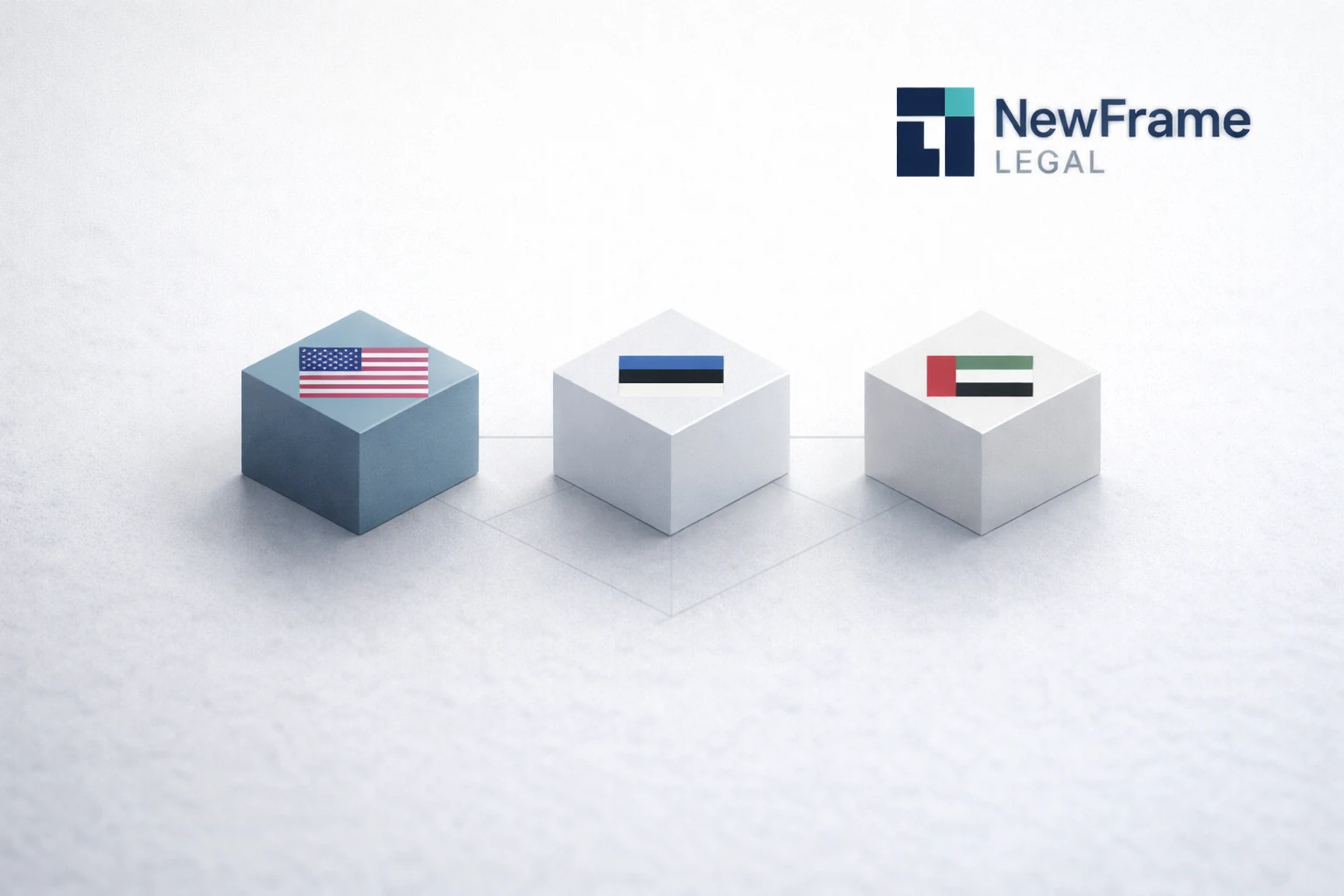
Where you incorporate shapes more than your tax bill. It determines which investors will talk to you, how easily you can hire and pay internationally, what your counterparties think when they see your invoices, and how painful your exit will be. The three jurisdictions founders ask about most — Delaware, Estonia, and the UAE — serve genuinely different purposes.
Delaware C-Corp
Delaware is the default for US-facing startups raising from US venture capital. Over 80% of VC-backed companies in the US are incorporated in Delaware. The reasons are structural, not tax-driven: Delaware's Court of Chancery has 200 years of corporate law precedent, US institutional investors require Delaware entities as a condition of investment, and the documentation ecosystem (SAFEs, term sheets, SHA templates) is built around Delaware law.
Delaware is not a tax haven for operating companies. A Delaware C-Corp pays US federal corporate tax at 21% plus Delaware state franchise tax. The tax advantage only materialises if the company's operations are genuinely offshore. For a European or Asian startup that merely incorporates in Delaware to access US VC, the operational tax profile depends on where the business is actually run.
Use Delaware if: you are raising from US institutional VCs; your primary market is the US; you plan a US IPO or acquisition.
Estonian OÜ
Estonia's defining feature is its corporate income tax model: 0% on retained profits, 22% only on distributed profits (rate confirmed at 22% for 2026 — the Estonian Parliament voted in December 2025 to cancel a previously announced increase). This makes Estonia genuinely attractive for reinvesting companies, not because it avoids tax, but because it defers it until you take money out.
Estonia's e-Residency program allows non-residents to establish and manage an Estonian company entirely remotely, with the company formation process taking approximately 15 minutes online. Estonia is an EU member state, which means SEPA payment access, EU VAT system (including the OSS for cross-border digital services), and EU regulatory alignment — important for enterprise sales to European clients.
Use Estonia if: you are building a European business and reinvesting profits; you want EU regulatory status; your clients are EU enterprises that prefer EU counterparties.
UAE Free Zone
The UAE introduced a 9% federal corporate tax in 2023, but qualifying free zone entities that meet substance requirements continue to benefit from a 0% rate on qualifying income. The UAE offers zero personal income tax, straightforward company setup in jurisdictions like DMCC, ADGM, and DIFC, and proximity to MENA and South Asian markets.
The UAE works well for founders who have personally relocated there, or for businesses with genuine Gulf-region operations or trading activity. For a company whose clients, employees, and operations are primarily in Europe, a UAE entity creates friction: SEPA access is limited, and EU enterprise clients may view Dubai-registered vendors differently than EU-registered ones.
Use the UAE if: founders are personally based in the Gulf; the business serves MENA markets; you are in Web3, commodities trading, or international logistics.
Common multi-jurisdiction structures
Many growth-stage companies use a combination: a Delaware or Estonian holding entity for investor relations and IP ownership, with an operational subsidiary in the country where the team works. The choice of combination depends on where you are raising capital, where your team is, and where your customers are — not on a generic tax optimisation pitch.